Showing posts with label art. Show all posts

Saturday, November 26, 2022

A.I. (Artificial Intelligence) - A Help or Hindrance to the Artist? -- Musings on Midjourney

As somebody who's (at least somewhat) creatively/artistically inclined, I find myself absolutely stunned by the recent advancements made in AI-rendered art. However, I admit to being conflicted and of two minds over such.

Half of me has that giddy mindset of a "kid-in-a-candy-store", especially when I experiment with Midjourney -- for the unfamiliar, "an independent research lab that produces a proprietary artificial intelligence program that creates images from textual descriptions" -- or see what others can come up with.

In its current state, which is still very much in its infancy (MidJourney beta only being released in 2022), AI-generated art gives a whole new meaning to the phrase, "the imagination is the limit", having the ability to render whatever the user wants, based on a unique prompt. Admittedly there is some level of SKILL required in utilizing the prompts, learning what particular kind and combination of prompts achieves the desired result. But in any case, the images that Midjourney produces -- spanning practically every genre and style and medium -- are absolutely, completely mind-boggling. See, for example, the regular postings to the Official MidJourney Facebook page.

But there's another part of me that is tentative, even fearful, for the potential impact it can have on artists and photographers and illustrators. What does it mean, for instance, when you can render a painted image in a matter of MINUTES, that would take a human literally days or weeks to produce on their own, using skills they have spent the bulk of their lives honing and cultivating as a craft?

What are the implications ... when I read that the first portrait created using artificial intelligence sold at auction in 2018 for $432,500; and that only this year, a Midjourney AI-generated painting won first place in the Colorado State Fair?

According to Kevin Roose, A.I.-generated art is already transforming creative work, both positively and not necessarily so. Some artists are less concerned than others about the impact AI may have on their careers, as in the example of an interior designer who has figured out how to use AI to streamlining their work, fleshing out prospective ideas for office-renovation in real-time. On the other hand you have stories like this:

"Initially, Mr. Waldoch planned to hire human artists to illustrate each day’s rhyming word pair. But when he saw the cost — between $50 and $60 per image, plus time for rounds of feedback and edits — he decided to try using A.I. instead. He plugged word pairs into Midjourney and DreamStudio, an app based on Stable Diffusion, and tweaked the results until they looked right. Total cost: a few minutes of work, plus a few cents.

“I typed in ‘carrot parrot,’ and it spit back a perfect image of a parrot made of carrots,” he said. “That was the immediate ‘aha’ moment.”

Mr. Waldoch said he didn’t feel guilty about using A.I. instead of hiring human artists, because human artists were too expensive to make the game worthwhile."

On the other hand, David Holz, the founders of Midjourney, was interviewed by Forbes and was largely dismissive of the idea that AI-generated art would have a negative impact on artists themselves:

... think that some people will try to cut artists out. They will try to make something similar at a lower cost, and I think they will fail in the market. I think the market will go towards higher quality, more creativity, and vastly more sophisticated, diverse and deep content. And the people who actually are able to use like the artists and use the tools to do that are the ones who are going to win.

These technologies actually create a much deeper appreciation and literacy in the visual medium. You might actually have the demand, outstrip the ability to produce at that level, and then maybe you'll actually be raising the salaries of artists. It could be weird, but that's what's going to happen. The pace of that demand increase for both quality and diversity will lead to some wonderful and unexpected projects getting made.

A generation of students graduated art schools, many of them heavily in debt, counting on relatively well-paid jobs in entertainment production, videogame production, commercial art and so on. How does the emergence of AI text-to-image platforms impact their future?

I think some people will try to cut costs, and some people will try to expand ambitions. I think the people who expand ambitions will still be paying all those same salaries, and the people who try to cut costs, I think will fail.

Of similar concern are the copyright and privacy issues involved. Take this story of fantasy artist Greg Rutkowski, who found his own original work quickly overtaken and overwhelmed online by AI-generated replications:

Rutkowski was initially surprised but thought it might be a good way to reach new audiences. Then he tried searching for his name to see if a piece he had worked on had been published. The online search brought back work that had his name attached to it but wasn’t his.

The article goes on to describe the experience of others -- illustrators, photographers, models, actors and actresses, directors, cinematographers" -- who are grappling with the fact that their work is being fed into the 5.8 billion dataset used by AI. It is currently the case that artists don’t have the choice to opt in to the database or have their work removed.

Anyway ... no offense intended in this post to those who use Midjourney and are demonstrably very adept at guiding it to producing what they desire. I honestly remain very much enthralled by its potential and entertainment value.

But lurking in the back of my mind are the questions and the issues raised in these articles as well.

Wednesday, February 17, 2021

Victor Ambrus (1935-2021)

Chances are if you ran across children’s book or YA editions of timeless classics like Moby Dick, The Iliad, The Oddysey, Don Quixote, King Arthur, The Canterbury Tales, Shakespeare, J.R.R. Tolkien, English, Irish and Hungarian military history, as well as stories from The Bible — you may well have encountered the gorgeous, unique and unmistakeable illustrations of Victor Ambrus (1935-2021), who passed away last Wednesday (February 10th).

"... back in 1956, [Victor Ambrus] took part in the Hungarian Uprising. After escaping from a building with his fellow students when it came under fire from the Soviets, he eventually decided to leave his native Hungary and moved to England. After arriving in London, he continued his artistic dream and began to study at the Royal College of Art.

Whilst studying at the RCA, Victor embarked upon his first job as an illustrator, at just 20 years old. This first assignment was to illustrate the History of Britain for the Reader's Digest. This started his career as a historical illustrator, which has lead to him illustrating almost 300 books." -- Time Team

Related

Tuesday, May 16, 2017

Desert of Forbidden Art (Documentary)

Sunday, February 26, 2017

Shusaku Endo's "Silence"

The Film

  • Some thoughts on Silence Opus Publicum 01/17/17:
    ... Silence is not a movie for the immature, nor is it a work that can be comprehended by modern sensibilities. The Tridentine Catholicism that not only animates the plot but supplies the movie’s richest symbolisms is thoroughly alien to an era shot through with religious indifferentism and cultural relativism. Protestants, no less than secularists, are apt to misunderstand the film’s fusion of sign and substance, particularly the torment that surrounds the mere possibility of trampling upon an image of Christ. Moreover, by quietly pointing to the kenotic Christ, that is, the Savior who suffers not just for us but with us, Silence taps into a rich tradition of authentically Catholic spirituality, one that is infused not just with the history of Japanese Catholicism, but Eastern Slavic piety as well.
  • Some thoughts on the movie Silence by Dr. Philip Blosser 01/29/17:
    ... I think that not only the temptations but the consequences of apostasy were shown by both novel and film in a faithful light: the temptations were beyond ingenious, with the voice of Jesus seeming to come from His image on the fumie itself ("Step on me.") as if Christ Himself were counseling the mercy of apostasy as the path to redemption; and both apostate priests ended their lives by faded into oblivion, morphing into gollum-like shadows of themselves; and the Japanese Catholics (not all, but many) who witnessed their apostasy were significantly demoralized by it.

    Remarkably, however, when Catholic priests returned to Japan after the Meiji Restoration of the mid-nineteenth century, they encountered Kakure Kurishitan (hidden Christians) who came out of hiding once again to present rosaries and crucifixes and statues of Maria Kanon that doubled as secret images of the Madonna, showing that the Faith had not been entirely wiped out. The price of persecution as well as apostasy was high. Only something like one tenth of 1% of Japanese people are Christians, and of these, half (about 509,000) are Catholic.

  • Scorsese's 'Silence' is his most Catholic film, by Sr. Rose Pacatte. National Catholic Reporter 12/21/16:
    At the top of the thematic list are faith and doubt as partners in a dangerous dance from the moment the priests first find out about Ferriera's apostasy. They leave Portugal and Rome, their gaze focused on a land far away, bolstered by a faith yet untested. Rodrigues especially carries in his heart the image of Jesus so dear to him as a child and in the seminary. Once imprisoned it comes to him in the suffering of the people and in the night. It is this Jesus with whom he converses about his doubts, his questions and the choice he faces.

    The high-pitched whine of the highly intelligent and informed inquisitor Inoue, with his polite manners and saccharine but sinister smile, do not mask his intent to break the resolve of the Christians. He challenges Rodrigues, as does Ferriera when he and Rodrigues finally meet, saying that Christianity is too Western and cannot adapt to Japan. Rodrigues says that the church is the source of truth and is unable to move off the script he learned growing up in Catholic Portugal. His responses to Inoue are noble perhaps, but ineffective. The inculturation of the Gospel and adaptation, even today, remains a challenge to those who evangelize, at home or afar.

    Kichijiro, absolved again and again for his apostasy, is emblematic of sinners who are self-aware of their sin and just as cognizant of God's mercy. Kichijiro disgusts Rodrigues, and it takes the priest a long time to realize that he, too, is a weak human not so different from this dirty beggar of a sinner who cannot help himself.

The Novel

  • Reading Silence for the first time, by Amy Welborn. Catholic World Report 12/14/16:
    ... Endo was inspired to write Silence, not only by his own life experience of living as a Japanese Catholic, but specifically by visiting the shrine to the Twenty-Six Martyrs in Nagasaki. This memorial commemorates men, women, and children killed in 1597, and includes an exhibit of fumi—the images of Christ, and sometimes of Mary, upon which Japanese Catholics were ordered to trample and spit, not only once, but annually, an obligation that persisted until the mid-19th century.

    Endo based his novel on historical documents, including a 17th-century diary written by a clerk in a residence in which apostate Catholics, including Giuseppe Chiara, lived. This is especially important for the final chapter of the novel. ...

    Endo is posing that question, in a way, to all Japanese Christians, and even all Japanese people, who live today in a culture shaped by martyrdom and apostasy, of oppressor and victim. What does it mean to contemplate the well-worn fumie in the museum and know that your faith in the present day exists, not only because of the seeds sown by the martyrs’ blood, but also because it was passed down by those who for years trampled and betrayed in public, while preserving what they could in private?

    The dilemma of trampling on the fumie can be brought home in more universal terms, as Endo himself noted, and perhaps this is one reason why this novel about Catholic missionaries who lived and died centuries ago plants a persistent pebble in the shoe of so many readers’ consciences. As Fujimoro beautifully puts it,

    Endo saw fumi-e as emblems of a greater, universal impact. When in lectures he spoke of “having a personal fumi-e,” he was not speaking of a literal religious icon, but was acknowledging that each of us steps on and betrays the “face of ones that [we] love, even the ideals [we] cherish.” To step on one’s own fumi-e, in that sense, is to betray oneself out of desperation due to public or cultural pressure. … Silence is not a triumphant pilgrimage with clear outcomes, but a meandering pilgrimage of one wounded by life and confounded by faith, whose experience of faith has been punctuated by betrayals, his own and those of others. Endo notes repeatedly in his memoirs and through his characters that through his own struggles of faith God never let him go. Endo himself is like the fumi-e, a historical marker birthed of a traumatic time, finally worn smooth through many disappointments, failures, and betrayals, but whose surface reveals the indelible visage of a Savior.

History

  • Kirishitan - Excellent site summarizing the history of Catholicism in Japan (HT: Amy Welborn).

  • Italian priest imprisoned in 18th century may have been influential in Japan’s development :
    Historians say [Jesuit missionary Giovanni Battista] Sidotti helped shape Japan’s view of the Western world with his knowledge after he won over the nation’s leading scholar of the day. But he fell from grace after refusing to give up his faith and his final days and death have been shrouded in mystery. . .

    As part of his interrogations, Sidotti was questioned by Japan’s top Confucian scholar, who developed a deep respect for the Roman Catholic priest for his knowledge of geography, languages and global affairs, experts said.

    The scholar, the renowned Hakuseki Arai, is said to have tried to help Sidotti but the priest was later sent to the dungeon amid allegations he baptized the Japanese couple tending to his daily needs.

    The Italian died there, but it is not clear how, researchers said.

    Historical accounts, including those written by Japanese scholar Kotonobu Mamiya about a century later, however, mention that Sidotti was accorded a certain respect and treated far better than other prisoners — even in death.

    The buried remains of what archeologists believe to be those of Sidotti were recently discovered. Evidence indicates he was given a burial "in the Christian way" out of respect.

Thursday, August 5, 2010

Peter Hitchens on The Last Judgement

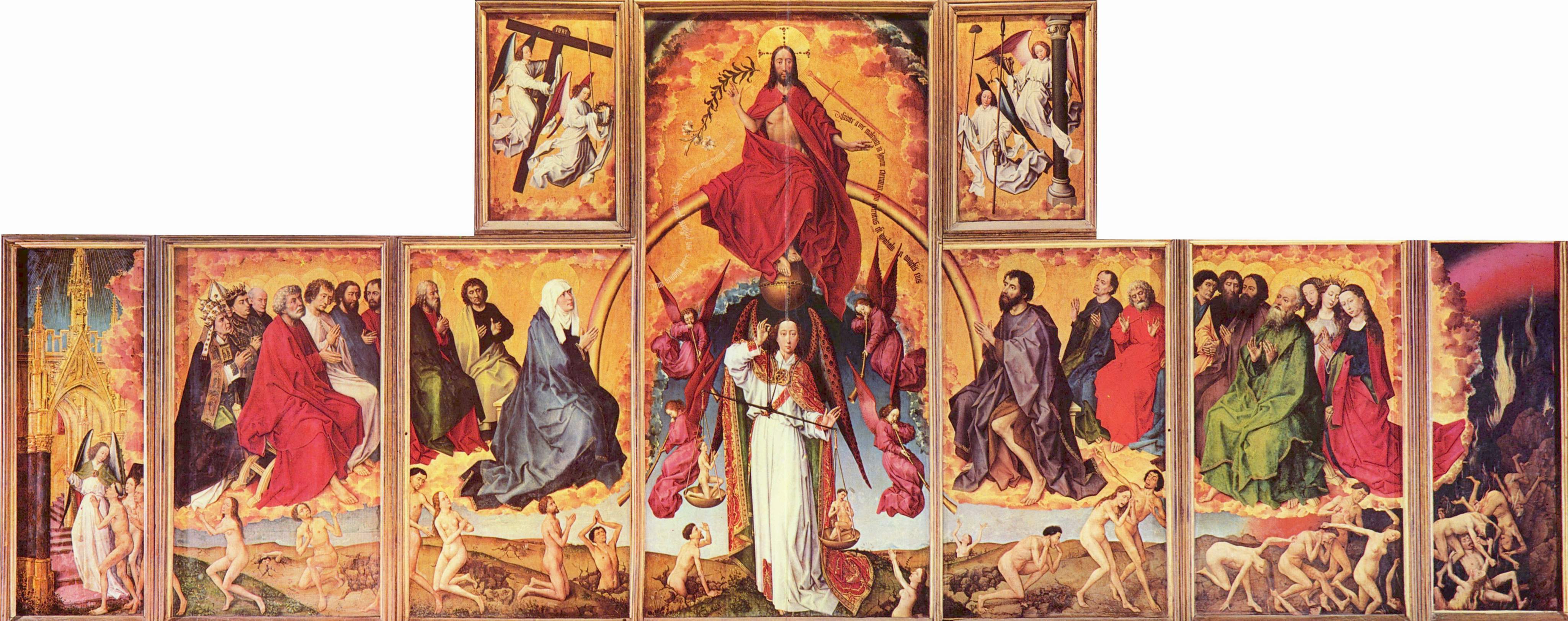
On a cycling trip to Burgundy he saw Rogier van der Weyden’s 15th-century Last Judgment, and this made a lasting impression. “I had scoffed at its mention in the guidebook, but now I gaped, my mouth actually hanging open, at the naked figures fleeing towards the pit of hell. I had a sudden strong sense of religion being a thing of the present day, not imprisoned under thick layers of time. My large catalogue of misdeeds replayed themselves rapidly in my head. I had absolutely no doubt that I was among the damned, if there were any damned. Van der Weyden was still earning his fee, nearly 500 years after his death.”
-- "The Day Peter Hitchens Gimpsed Hell" (Catholic Herald August 5, 2010) -- in which the author of The Rage Against God: How Atheism Led Me to Faith (and brother of the infamous atheist Christopher Hitchens) describes how a painting put the fear of God into his soul and put him on the straight and narrow.
Sunday, May 16, 2010

Lars Vilks, "Gay Muhammad" and "Freedom of Expression"

This past week brings news of yet another fracas involving Swedish cartoon artist Lars Vilks (CNN.com):
When Vilks entered a classroom where he was to deliver a lecture to about 250 people -- all of whom had passed through a security checkpoint to gain admission -- about five people started protesting loudly, Eronen said.
After Uppsala uniformed and non-uniformed police calmed the protesters, the lecture got under way at about 5:15 p.m. (11:15 a.m. ET), Eronen said.
But as Vilks was showing audiovisual material, 15 to 20 audience members became loud and tried to attack Vilks, he said. As police stepped in, a commotion started and Vilks was taken to a nearby room; police used pepper spray and batons to fend off the protesters, Eronen said. Vilks did not return to the lecture. [Video footage of the event]. Last March, an American woman who called herself "Jihad Jane," Colleen LaRose, was indicted in the United States for allegedly conspiring to support terrorists and kill Vilks.
In a 2007 interview with CNN he had drawn the cartoon of Mohammed with a dog's body in order to take a stand.
" "I don't think it should not be a problem to insult a religion, because it should be possible to insult all religions in a democratic way, " says Vilks from his home in rural Sweden.

"If you insult one, then you should insult the other ones."

His crude, sketched caricature shows the head of Prophet Mohammed on the body of a dog. Dogs are considered unclean by conservative Muslims, and any depiction of the prophet is strictly forbidden.

Vilks, who has been a controversial artist for more than three decades in Sweden, says his drawing was a calculated move, and he wanted it to elicit a reaction.

"That's a way of expressing things. If you don't like it, don't look at it. And if you look at it, don't take it too seriously. No harm done, really," he says.

When it's suggested that might prove an arrogant -- if not insulting -- way to engage Muslims, he is unrelenting, even defiant.

"No one actually loves the truth, but someone has to say it," he says.

Vilks, a self-described atheist, points out he's an equal opportunity offender who in the past sketched a depiction of Jesus as a pedophile.

Monday, April 19, 2010

Barbara Nicolosi: "the Church has lost its way in modernity"

The fact that there is not a single Christian university in the top twenty film programs in the world is a sign that the Church has lost its way in modernity. We are not seeing ourselves as people of this moment.

The saddest realities to look at are not Hustler magazine and Big Love. Much more tragic is what you find on EWTN and CBN, because these things are devoid of creativity and devoid of respect for the audience. They are banal. They may be produced with the best of intentions, but they have no sense of the appropriateness of the art form, of using the medium to its full potential.

Sad though it is, you would never call the Church the patron of the arts today. Never. You would be laughed down. I know that to be true. I used the phrase with a class of undergrads. A young woman raised her hand and said, "Who is the ‘patron of the arts'?" I asked the students who they thought the patron of the arts is. They looked at me for a while, and finally one kid raised his hand and said, "The Bravo Channel?"

"Patron of the arts" used to be the moniker of the Christian Church. But this generation has no experience of the Church being a patron of the arts. We are so far behind in being a compelling voice in the culture. We have allowed our voice in culture to disappear.

From: The Church of the Masses An interview with Barbara Nicolosi-Harrington. Patheos March 2, 2010.

Monday, December 14, 2009

"Drawn to Catholicism"

A new blog discovery:

saintos [a.k.a. Owen, i.e. me] is the author/illustrator of drawntocatholicism which is a comic diary by a Catholic convert / husband / father / artist / perish catechist / urban cyclist / dog lover…
Check it out.

Thursday, November 26, 2009

Great News for Fans of "Bloom County"

Not subscribing to a newspaper I rarely have occasion to read the comics these days -- but my childhood and teenage years were spent devouring "Calvin and Hobbes", Trudeau's "Doonesbury" and Berkley Breathed's "Bloom County" (circa 1980-1989). For those who don't recognize the latter, IDW Publishing has announced the launch of The Bloom County Complete Library -- "a five volume collection featuring every daily and Sunday strip in chronological order, many reprinted for the first time."
The Bloom County Library will also contain a series of "Context Pages" sprinkled throughout the volumes, providing perspective for the reader and presenting a variety of real-life events and personalities that were contemporary at the time of original publication.
In a recent interview with Los Angeles Times' "Hero Complex", Breathed describes the circumstances that led to his decision to relenquish cartooning:
“When you’re young, you miss things, you just don’t see them,” said the 52-year-old Breathed, who walked away from comic strips last year because the Digital Age had eroded his newsprint audience and, worse, his artistic vigor and sense of whimsy. [...]

“Not to sound like someone swinging their cane, but in the 1980s there weren’t a thousand other voices screaming to be heard at the same time,” Breathed said of the decade when his “Bloom County” was featured in more than 1,200 newspapers and he won the Pulitzer Prize for editorial cartooning. “There was a quiet in the room that made being a commentator very exciting. There was no Web, there was barely any cable TV. If you were looking for humorous topical commentary, you would go to the Johnny Carson monologue, ‘Saturday Night Live’ and ‘Doonesbury.’ That was it. After you have the silence of that room, you get really weary with the screaming it takes today. There’s also this bitterness in the public square now that is difficult to avoid. I never did an angry strip, but in recent years I saw that sneaking in.

Breathe goes on to discuss Peanuts' Charles Schulz ("The major regret in my cartooning life is I didn’t get to know him"); Doonesbury's Garry Trudeu ("He came as close to a hero for me as I was going to have in the comics world") and Calvin & Hobbes' Bill Watterson ("Breathed’s fan, friend and rival").

Having departed from the world of comic-strips, Breathed now writes and illustrates children's books.

Sunday, September 6, 2009

"Manufactured Landscapes" - Photographs of Ed Burtynsky

"Manufactured Landscapes" -- an incredible documentary I saw this week on IFC. Aesthetically and morally provocative. From the artist's website:
MANUFACTURED LANDSCAPES is a feature length documentary on the world and work of renowned artist Edward Burtynsky. Burtynsky makes large-scale photographs of ‘manufactured landscapes’ – quarries, recycling yards, factories, mines, dams. He photographs civilization’s materials and debris, but in a way people describe as “stunning” or “beautiful,” and so raises all kinds of questions about ethics and aesthetics without trying to easily answer them.

The film follows Burtynsky to China as he travels the country photographing the evidence and effects of that country’s massive industrial revolution. Sites such as the Three Gorges Dam, which is bigger by 50% than any other dam in the world and displaced over a million people, factory floors over a kilometre long, and the breathtaking scale of Shanghai’s urban renewal are subjects for his lens and our motion picture camera.

Shot in Super-16mm film, Manufactured Landscapes extends the narrative streams of Burtynsky’s photographs, allowing us to meditate on our profound impact on the planet and witness both the epicentres of industrial endeavour and the dumping grounds of its waste.

"... I think the work that I do, and the work that I did for 20 years before I even got to doing China, is, in a way, a lament. It's a lament for a loss of our natural world. So, in a way, the work champions that world, and looks at it, and tries to remind us that our built environment comes from somewhere, and that we just have ignored it.
We've moved on to the new ages: the Information Age, the Biological Age; that's what occupies our mind. But the Stone Age and the Iron Age and the Copper Age are all alive and well, and expanding on a level that is breathtaking. So, in a way, it's like our consciousness is forging ahead into the new world, but I think it's those old worlds that can come up from behind us and undercut our ambition, so to speak.
So, to me, the work is this meditation, is this walking through those worlds, through these wastelands that have been left behind, through that residual kind of place in the world where the taking has happened and we've walked away, and try to remind us that there is this other side to the built world that we have."
From Ed Burtynsky and "Manufactured Landscapes" Interview w. Collin Dunn. Treehugger.com. June 27, 2007.

See also: Photography by Edward Burtynsky on Amazon.com.

Monday, August 24, 2009

Divine symmetry.

What is a fractal?
A fractal is generally "a rough or fragmented geometric shape that can be split into parts, each of which is (at least approximately) a reduced-size copy of the whole,"[1] a property called self-similarity. Roots of mathematical interest on fractals can be traced back to the late 19th Century, the term however was coined by Benoît Mandelbrot in 1975 and was derived from the Latin fractus meaning "broken" or "fractured." A mathematical fractal is based on an equation that undergoes iteration, a form of feedback based on recursion. [...]

Because they appear similar at all levels of magnification, fractals are often considered to be infinitely complex (in informal terms). Natural objects that approximate fractals to a degree include clouds, mountain ranges, lightning bolts, coastlines, snow flakes, various vegetables (cauliflower and broccoli), and animal coloration patterns. [Wikipedia]

If you have an spare hour on your hands, I heartily recommend this episode of PBS' Nova on Fractals: Hunting the Hidden Dimension on the discovery of fractals and their manifestation in ; further info can be found on their accompanying website.

For a mind-blowing demonstration of a fractal's scale, explore the infinite detail of a Mandelbrot set as you zoom to a magnification of 250,000,000x.

Bookmark and Share

Sunday, April 6, 2003

Witness of an artist

"From the very day I was released, I began to implement my plan to paint a series of pictures on the theme of the Gulag, but because this was a forbidden topic, I had to do my civic duty in secret. And so, in complete secrecy, beginning in 1953, I painted pictures about camp life that I recreated from memory. I told no one about this work—not even my wife—because this sort of activity was punishable by imprisonment or even death. I undertook the task because I was convinced that it was my duty to leave behind a testimony to the fate of the millions of prisoners who died and who should not be forgotten."

Nikolai Getman: The Gulag Collection